[태그:] passive income 2026

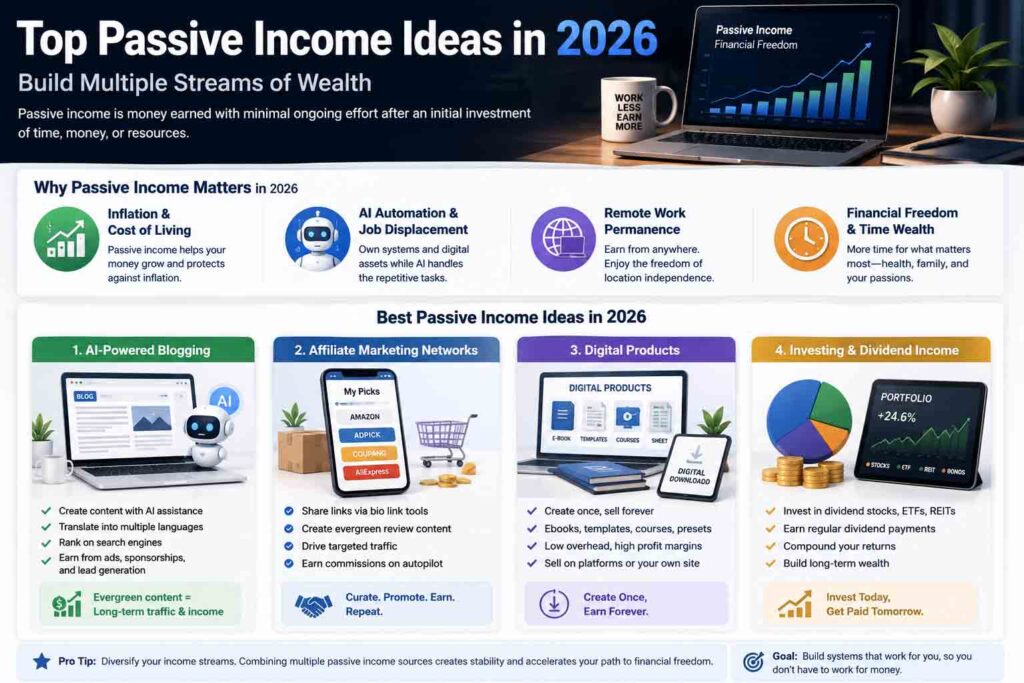
  • Imagine waking up tomorrow and realizing your investments, digital products, and online businesses earned money while you slept. That is the true power of passive income. In 2026, building multiple income streams is no longer a luxury—it is becoming a financial necessity.

    Imagine waking up tomorrow and realizing your investments, digital products, and online businesses earned money while you slept. That is the true power of passive income. In 2026, building multiple income streams is no longer a luxury—it is becoming a financial necessity.

    Imagine waking up tomorrow to discover that your investments, digital products, affiliate websites, and online businesses earned money while you slept.

    That is the true power of passive income.

    In 2026, building multiple streams of income is no longer just a smart financial strategy—it has become an essential step toward long-term financial security, freedom, and resilience in an AI-driven economy.

    Introduction

    The global financial ecosystem has undergone a profound structural shift. For decades, the traditional path to financial security relied on a single, predictable linear equation: exchanging finite human hours for a fixed active salary. This paradigm, while stable during periods of low inflation and predictable market cycles, has proven increasingly fragile. In 2026, the intersection of macroeconomic volatility, persistent inflation, and the rapid rise of automated technologies has transformed passive income from an aspirational luxury into an essential pillar of wealth preservation.

    The modern worker faces unprecedented pressures. Central bank policies across the United States, the United Kingdom, Canada, and Australia continue to struggle with structural cost-of-living increases. Concurrently, the mass integration of advanced artificial intelligence and autonomous digital workers has fundamentally altered the labor landscape. Mid-level corporate roles are being re-engineered, project-based freelance economies are replacing long-term employment contracts, and the longevity of any single active income stream has shortened significantly. As a result, building automated, scalable, and resilient asset structures that generate revenue independent of active labor has become a critical strategy for financial survival and wealth accumulation. This comprehensive guide provides an exhaustive analysis of the ten most viable passive income strategies engineered for the economic realities of 2026.


    What Is Passive Income?

    To build a reliable multi-stream financial foundation, one must first deconstruct the underlying mechanics of passive revenue. Misunderstanding the core principles of capital and labor leverage is the primary reason most wealth-building initiatives fail within their first twelve months.

    Defining the Leverage Mechanism

    In its truest sense, passive income is money generated by an asset structure that does not require continuous, real-time active labor to maintain its revenue output. It represents an asymmetric return on an initial upfront investment. That investment must take one of two forms: financial capital or sweat equity.

    • Financial Capital Leverage: This involves deploying existing cash into vehicles that inherently yield returns, such as dividend-paying equities, debt instruments, or fractional real estate holdings. Capital leverage requires minimal initial time but demands upfront liquidity.
    • Sweat Equity Leverage: This involves investing concentrated blocks of time, intellectual property, and creative focus into building a scalable digital or operational infrastructure, such as an online course, a software utility, or an affiliate marketing network. Once built, the marginal cost of distribution drops to near zero, decoupling future revenue from future hours worked.

    Active vs. Passive Income

    The core distinction between active and passive income lies in how the wealth generation loop handles time. Active income requires symmetric transaction loops. If a corporate executive, an attorney, or a skilled tradesperson stops performing work for a single day, their revenue stops immediately. Their income is bound by a hard physical ceiling: the 24 hours available in a day.

    Passive income operates via decoupled transaction loops. An asset—whether a corporate stock certificate or a digital product hosted on a cloud server—remains active in the global marketplace constantly. It collects revenue while the creator sleeps, travels, or focuses on building alternative asset classes.

    Common Misconceptions

    The financial media frequently misrepresents passive income, leading to significant disillusionment among beginner investors. Two major myths must be dispelled:

    The Zero Effort Myth: Passive income is not a magical, effort-free cash flow. Every passive income stream requires a heavy upfront commitment. You must either work intensely for months without immediate pay to build a digital asset, or save aggressively from your active job to accumulate investable capital. The passive phase only begins after the initial infrastructure is completed.

    The Set It and Forget It Perpetuity Myth: No asset class remains profitable forever without oversight. Real estate requires property maintenance and tax management; dividend portfolios require quarterly rebalancing; digital products require occasional software updates and brand maintenance. Passive income minimizes daily labor, but it does not eliminate systemic management.


    Why Passive Income Matters More Than Ever

    The modern economic environment requires an entirely new financial playbook. Relying on an isolated corporate salary is no longer a conservative choice; it represents a concentrated structural risk.

    Financial Freedom and Economic Uncertainty

    The traditional social contract between employers and employees has broken down across Western economies. Corporate downsizings are no longer tied exclusively to economic recessions; they are frequently driven by structural shifts toward efficiency and technical optimization. By building multiple independent cash flows, you insulate your household from the catastrophic impact of sudden job loss. True financial freedom is achieved when your recurring passive revenue covers your baseline cost of living, giving you the leverage to walk away from toxic work environments and make career choices based on fulfillment rather than financial survival.

    The Impact of AI Automation and Remote Work

    The year 2026 marks the mature phase of the autonomous technology revolution. AI agents and machine-learning workflows are no longer conceptual novelties; they are actively managing logistics pipelines, drafting legal compliance frameworks, auditing financial spreadsheets, and programming software platforms.

    While this shift displaces certain traditional roles, it provides an unprecedented advantage to independent digital entrepreneurs. The cost of launching a scalable online infrastructure has plummeted. A single individual, leveraging cloud automation and advanced software tools, can run an international e-commerce or digital content enterprise that previously required an entire operational team. Concurrently, the normalization of remote work has created a global consumer base that purchases, learns, and communicates entirely online, opening up clear paths to capture cross-border revenue.


    Top 10 Passive Income Ideas for 2026

    The following ten strategies represent the most practical, verifiable paths to generating non-active revenue in the current economic landscape.


    1. Dividend Investing

    How It Works

    Dividend investing is the classic method of capturing passive cash flow by purchasing shares in publicly traded companies that regularly distribute a portion of their corporate profits back to shareholders. Instead of focusing solely on speculative capital appreciation, dividend growth investors target mature, high-quality enterprises with a long history of increasing their payouts annually. Shareholders typically choose to automatically reinvest these distributions via a Dividend Reinvestment Plan (DRIP) to compound the asset base over time, eventually switching to direct cash distributions when they need to supplement their living expenses.

    Advantages

    • Minimal ongoing time commitment.
    • Highly liquid asset class that can be sold instantly in public markets.
    • Provides a natural hedge against inflation as quality companies raise prices and dividends simultaneously.

    Disadvantages

    • Requires a large amount of upfront financial capital to generate meaningful income.
    • Corporate boards can cut or suspend dividends during severe economic downturns.
    • Subject to dividend income taxation depending on your specific tax bracket and account structure.

    Key Metrics & Target Audience

    • Expected Returns: 3% to 6% annual dividend yield, excluding underlying equity price appreciation.
    • Risk Level: Low to Medium (market volatility dependent).
    • Best For: Long-term capital accumulators, corporate professionals with surplus cash, and retirees seeking stable income.

    2. High-Yield Savings Accounts

    How It Works

    High-Yield Savings Accounts (HYSAs) and short-term cash instruments utilize online-only banking infrastructure to offer significantly higher interest rates than traditional retail banks. Because online banks do not maintain expensive physical branch networks, they pass the operational savings back to depositors via competitive yields. In the current interest rate environment, maintaining cash in these vehicles ensures your liquid capital preserves its purchasing power while remaining completely safe from stock market fluctuations.

    Advantages

    • Virtually zero risk, with deposits insured up to legislative limits by federal organizations (such as the FDIC in the US or the FSCS in the UK).
    • Instant accessibility and maximum liquidity for emergency funds.
    • Extremely straightforward setup requiring zero technical or financial expertise.

    Disadvantages

    • Yields are tied directly to central bank interest rate policies and will fall if national rates decline.
    • Returns rarely outperform high-quality equities over long horizons.
    • Inflation can still erode real purchasing power if consumer prices outpace the bank’s net yield.

    Key Metrics & Target Audience

    • Expected Returns: 4% to 5.5% annual percentage yield (APY).
    • Risk Level: Very Low.
    • Best For: Risk-averse individuals, beginners building an emergency fund, and investors holding capital for near-term deployments.

    3. ETF Investing

    How It Works

    Exchange-Traded Funds (ETFs) allow investors to purchase a single basket of hundreds of diversified assets in a single transaction. Instead of taking on the concentrated risk of picking individual stocks, an ETF investor tracks whole indexes, such as the S&P 500, total stock markets, or high-yield corporate bond indexes. This strategy forms the core of modern passive index investing, focusing on broad economic growth and rock-bottom management fees to maximize compound wealth over decades.

    Advantages

    • Instant structural diversification across multiple business sectors and geographic regions.
    • Extremely low expense ratios, protecting your wealth from being eaten away by high advisory fees.
    • Completely automated hands-off management via automatic monthly deposit allocations.

    Disadvantages

    • Returns are bound directly to the average performance of the broader market, eliminating the chance of outsized short-term gains.
    • Subject to systemic macroeconomic market corrections and global geopolitical shocks.
    • No direct control over the individual corporate components within the fund.

    Key Metrics & Target Audience

    • Expected Returns: 7% to 10% average annualized long-term total return (compounded).
    • Risk Level: Medium.
    • Best For: Hands-off wealth builders, busy professionals, and families securing multi-decade retirement funds.

    4. Real Estate Crowdfunding

    How It Works

    Real Estate Crowdfunding platforms pool financial capital from thousands of individual investors to acquire large-scale commercial buildings, residential developments, or multi-family apartment complexes. This structure democratizes access to institutional-grade real estate, allowing individuals to capture the benefits of property ownership—such as monthly rental distributions and long-term equity appreciation—without managing tenants, handling broken plumbing, or negotiating complex bank commercial mortgages.

    Advantages

    • Allows fractional real estate investment with low capital entry requirements.
    • Provides a true physical asset hedge that is completely uncorrelated with daily stock market volatility.
    • Managed entirely by professional real estate firms that handle development, tenancy, and maintenance.

    Disadvantages

    • Highly illiquid; capital is frequently locked inside a project for three to seven years.
    • Platform management and performance fees can reduce overall investor returns.
    • Project developers can default or experience construction delays if real estate markets soften.

    Key Metrics & Target Audience

    • Expected Returns: 6% to 12% annualized returns via a combination of dividends and equity appreciation.
    • Risk Level: Medium to High.
    • Best For: Investors looking to diversify outside of equity markets, and individuals wanting real estate exposure without property management hassles.

    5. Digital Products

    How It Works

    Creating digital products involves writing, designing, or programming a downloadable asset once and selling it infinitely via automated e-commerce platforms. Common examples include specialized Notion templates, website themes, eBook guides, Lightroom photography presets, 3D printing design files, or custom Excel spreadsheet configurations for specific business niches. Because the asset is delivered as a digital download, the cost of manufacturing and shipping additional units is zero.

    Advantages

    • Uncapped profit margins because there are no inventory storage costs or shipping overhead fees.
    • Global market reach, selling to consumers across multiple continents instantly.
    • Complete ownership of the intellectual property, allowing for infinite variations and bundle options.

    Disadvantages

    • Requires a high upfront investment of time, design skills, or technical knowledge to build something valuable.
    • Digital marketplaces are crowded, requiring a clear marketing or search optimization strategy to stand out.
    • Piracy and unauthorized distribution can impact long-term revenue pipelines.

    Key Metrics & Target Audience

    • Expected Returns: Highly variable; ranging from a few hundred dollars a month to six-figure automated enterprises.
    • Risk Level: Low (Financial risk is low, but time investment is high).
    • Best For: Graphic designers, software developers, technical writers, and creative professionals.

    6. AI-Powered Online Businesses

    How It Works

    This strategy centers on building specialized software micro-utilities (Micro-SaaS) or niche web applications that leverage public machine-learning APIs to automate specific business tasks for users. Examples include automated resume keyword optimizers, niche translation tools, code syntax validators, or custom data formatting dashboards. By creating a lightweight subscription utility, customers pay a monthly fee to access a tool that solves an ongoing business problem.

    Advantages

    • Extremely high scalability; cloud servers automatically scale to handle additional users without manual intervention.
    • Steady, predictable monthly recurring revenue (MRR) structures.
    • Modern development frameworks allow developers to build these tools faster than ever before.

    Disadvantages

    • Requires technical programming skills or the capital to manage external developers.
    • API dependency; changes to underlying models or pricing structures can disrupt your software utility.
    • SaaS markets face rapid competition, requiring constant product optimization.

    Key Metrics & Target Audience

    • Expected Returns: High scaling potential; $1,000 to $50,000+ monthly recurring revenue.
    • Risk Level: Medium to High.
    • Best For: Full-stack developers, software engineers, and technical product managers.

    7. Affiliate Marketing

    How It Works

    Affiliate marketing involves recommending specialized products or services through high-quality informational content, review sites, or digital channels. By integrating unique tracking links into your content, you earn a direct percentage commission every time a user executes a purchase through your link. Successful affiliate marketers focus on high-ticket enterprise software subscriptions (SaaS) or highly regulated financial services, as these categories offer recurring commissions for the entire lifecycle of the referred user.

    Advantages

    • Zero product development, customer service, inventory handling, or shipping responsibilities.
    • Low financial barrier to entry; requires only a fast website domain and high-quality content.
    • Can be paired easily with existing content channels, blogs, or review sites.

    Disadvantages

    • Completely dependent on the commission structures and cookie windows set by partner brands.
    • Search engine algorithm updates can suddenly disrupt organic traffic pipelines to your web assets.
    • Building trust and capturing consistent traffic requires months of high-quality informational output.

    Key Metrics & Target Audience

    • Expected Returns: $500 to $20,000+ per month based on traffic volume and niche monetization levels.
    • Risk Level: Medium.
    • Best For: Content writers, digital publishers, domain specialists, and review site operators.

    8. YouTube Automation

    How It Works

    YouTube Automation involves building highly engaging, faceless informational or educational channels where content production is systematically delegated to a freelance creative team. The owner acts as an executive producer, managing the system rather than appearing on camera. A writer drafts an educational script, a voice artist records the audio, an editor pieces together relevant high-quality stock footage, and the completed media asset is uploaded to YouTube to collect long-term ad revenue and sponsor distributions.

    Advantages

    • The content continues to generate AdSense revenue for months or years after publication as the algorithm recommends archived videos.
    • Scales efficiently; once a profitable operational workflow is established, multiple channels can be run simultaneously.
    • Diversified monetization models including ad revenues, affiliate links, channel memberships, and sponsorships.

    Disadvantages

    • Requires a significant upfront financial investment to pay freelance creative teams before the channel is monetized.
    • YouTube’s monetization review rules require strict compliance regarding content originality.
    • Channel growth curves can be unpredictable, often requiring several months of consistent uploads to gain traction.

    Key Metrics & Target Audience

    • Expected Returns: $1,000 to $30,000+ monthly ad revenue depending on the channel’s niche CPM metrics.
    • Risk Level: Medium to High.
    • Best For: Project managers, content agency owners, and digital system builders.

    9. Print-on-Demand

    How It Works

    Print-on-Demand (POD) is an e-commerce model where custom graphic designs are listed on merchandise—such as apparel, home goods, or office supplies—without purchasing any upfront inventory. When a customer places an order on your digital storefront, the purchase data automatically syncs to a third-party manufacturing supplier. The supplier prints the design on the item, packages it, and ships it directly to the end customer. The owner captures the clean spread between the retail customer price and the supplier’s wholesale cost.

    Advantages

    • Zero inventory risk; you never purchase an item until a customer has paid you for it.
    • Simple testing environment; you can test hundreds of cultural or niche designs without any financial loss.
    • The supplier handles 100% of the manufacturing, logistics, tracking, and delivery fulfillment.

    Disadvantages

    • Lower profit margins compared to traditional bulk-manufacturing e-commerce models.
    • Highly dependent on the product quality, printing accuracy, and shipping speeds of your supplier.
    • E-commerce marketplaces require persistent search optimization and trend tracking to capture consistent buyers.

    Key Metrics & Target Audience

    • Expected Returns: $200 to $5,000+ monthly profit margins.
    • Risk Level: Low.
    • Best For: Illustrators, graphic designers, pop-culture trend monitors, and e-commerce beginners.

    10. Online Courses

    How It Works

    Building online courses involves packaging your deep professional expertise or technical knowledge into a structured, high-value video curriculum. By uploading the completed modules to education networks or private community platforms, students globally can purchase and go through the training independently. Successful educators target specific, high-income skill transitions, such as mastering advanced corporate databases, preparing for engineering certifications, or learning data analytics architectures.

    Advantages

    • High asset value; premium, comprehensive education programs can command prices from $200 to over $1,000 per student.
    • Establishes your deep professional authority and opens up high-ticket consulting avenues.
    • Minimal distribution costs; teaching hundreds of students simultaneously requires no additional overhead.

    Disadvantages

    • Requires proven, verifiable expertise in a specific field and high-quality video production equipment.
    • Demands significant upfront time and focus to map out a clear, genuinely valuable curriculum.
    • Requires ongoing student engagement or community management to prevent high refund rates.

    Key Metrics & Target Audience

    • Expected Returns: $2,000 to $50,000+ monthly revenue.
    • Risk Level: Medium.
    • Best For: Corporate veterans, senior engineers, certified professionals, and experienced academic mentors.

    Passive Income Comparison Table

    Selecting the appropriate passive income vehicle requires a careful analysis of your current resources. Use the following comparative matrix to balance your investable capital against your risk tolerance and available time.

    Income StreamInvestment RequiredRisk LevelPotential ReturnTime CommitmentBeginner FriendlyLong-Term Growth
    Dividend InvestingHigh CapitalLow to MediumConsistent (3-6% Yield)Extremely LowYesExcellent
    High-Yield SavingsFlexible CapitalVery LowFixed (4-5.5% APY)Virtually ZeroYesLow (Inflation Limited)
    ETF InvestingLow Capital EntryMediumHigh (7-10% Compound)Extremely LowYesSuperb
    Real Estate CrowdfundMedium CapitalMedium to HighHigh (6-12% Annual)Very LowMediumGood
    Digital ProductsLow Cash / High TimeLowUncapped ScalingHigh Upfront SetupMediumModerate
    AI Online BusinessMedium Cash & TimeHighExtremely HighHigh DevelopmentNoExponential
    Affiliate MarketingLow Cash / High TimeMediumScalable GrowthHigh Upfront ContentMediumGood
    YouTube AutomationHigh Cash / Low TimeMedium to HighHighly ScalableHigh Systems ReviewNoExcellent
    Print-on-DemandLow Capital EntryLowModerate MarginsModerate UpfrontYesLinear
    Online CoursesLow Cash / High TimeMediumExceptionalHigh ProductionMediumOutstanding

    Real Case Studies

    To understand how these passive structures function in practice, let us examine five real-world case studies across different professional demographics.

    Case Study 1: The Young Corporate Professional

    • Profile: Sarah, 28, Senior Financial Analyst based in Chicago, US.
    • Strategy: Automated Index ETF Allocation + Dividend Reinvestment.
    • Execution: Sarah prioritized maximizing her automated savings rate early in her career. Living below her means, she configured her bank account to route $1,500 every month directly into low-cost index ETFs and high-yield dividend growth stocks. By utilizing automated DRIP structures, her portfolio compounds quietly without her logging into her brokerage account.
    • Result: After 6 years of consistent capital deployment, her portfolio generates over $850 a month in automated, hands-off reinvestment equity, giving her a major financial safety net as she advances into executive leadership roles.

    Case Study 2: The Freelance Creative

    • Profile: David, 34, Freelance Web Designer based in London, UK.
    • Strategy: Niche Digital Products (Notion UI Kits & Figma Web Templates).
    • Execution: David grew exhausted from trading billing hours for client revisions. Over a 4-month period, spending 10 hours every weekend, he developed a series of ultra-clean, minimalist design layout components for Figma and configured them into automated download funnels on personal storefronts. He created short, highly search-optimized breakdown articles on his portfolio site to capture incoming traffic.
    • Result: His digital design kits now generate between $2,200 and $3,500 every single month in pure, automated download profit while he focuses entirely on selecting only his favorite high-paying custom active design contracts.

    Case Study 3: The Small Business Owner

    • Profile: Marcus, 42, Commercial HVAC Contracting Company Owner based in Sydney, Australia.
    • Strategy: High-Ticket Affiliate Marketing + B2B Lead Pipelines.
    • Execution: Marcus realized that his corporate clients were constantly asking for recommendations on building management software and industrial climate-control monitoring systems. Instead of simply mentioning brand names, Marcus established official affiliate partnerships with top enterprise B2B SaaS platforms and set up an information hub on his business website.
    • Result: By directing enterprise clients to sign up through his custom resource links, Marcus secured an automated, recurring monthly contract commission stream of $4,100, which pays for his permanent office lease overhead completely independent of his active contracting work.

    Case Study 4: The Retiree

    • Profile: Elena, 67, Retired Secondary School Educator based in Toronto, Canada.
    • Strategy: Real Estate Crowdfunding + High-Yield Savings optimization.
    • Execution: Upon receiving her lump-sum retirement package, Elena wanted to move away from volatile stock markets while generating monthly income to supplement her pension. She avoided individual rental properties because she did not want the stress of property management. Instead, she routed 60% of her liquid cash into a high-yield savings ladder and 40% into vetted commercial real estate crowdfunding notes focused on essential multi-family housing blocks.
    • Result: This capital distribution provides her with a reliable, stress-free monthly cash influx of $1,650, allowing her to travel internationally without drawing down on her core cash reserves.

    Case Study 5: The Digital Entrepreneur

    • Profile: Alex, 31, Faceless Content System Builder based in Melbourne, Australia.
    • Strategy: High-Yield YouTube Automation Channels.
    • Execution: Alex utilized his knowledge of project management to treat content production like an assembly line. He chose high-CPM niches (personal finance and tech innovations) and put together a remote creative team consisting of a freelance scriptwriter, an audio voice professional, and an expert video editor. He uses cloud project boards to manage the upload queue, spending only 3 hours a week auditing completed files.
    • Result: Alex runs three automated channels that generate over $14,000 monthly in shared AdSense revenue and recurring affiliate integrations, allowing him to operate a location-independent business.

    Common Mistakes to Avoid

    The path to building a sustainable passive income stream is filled with psychological and operational traps. To protect your capital and your time, keep the following principles in mind.

    Unrealistic Expectations and the Sunk Cost Trap

    The most common point of failure is a distorted expectation of timing. Most digital or capital-leveraged assets require a minimum of six to twelve months of consistent cultivation before generating their first dollar of profit. Beginners frequently launch a blog, an automation channel, or a digital template shop, upload content for three weeks, and quit because they haven’t seen an immediate return. This creates a pattern of abandoned assets. You must approach passive income with a multi-year horizon, treating your early labor or capital deployments as long-term investments rather than short-term plays.

    Navigating Scams and Get Rich Quick Vehicles

    The wealth-building space is crowded with predatory platforms promising guaranteed astronomical yields with zero risk. Common examples include unregulated offshore crypto lending pools, copy-trading bots, and high-ticket mastermind courses that teach you nothing but how to resell that same course to others.

    The Universal Golden Rule of Finance: If an investment vehicle promises high returns with zero risk, you are looking at a scam. If the underlying mechanics of how a system makes money sound deliberately confusing or rely on constantly recruiting new participants, protect your capital and walk away immediately.

    Overleveraging and Poor Diversification

    When an investor discovers a profitable asset class, they often make the mistake of deploying 100% of their available resources into that single bucket. For example, putting your entire life savings into a single property loan notes portfolio or utilizing high debt to fund dozens of e-commerce stores exposes you to massive structural risk. If that specific market experiences an economic correction or an algorithm change occurs, your entire financial foundation can collapse overnight. True wealth security requires diversification: pair your high-growth digital businesses with conservative index equities and guaranteed liquid cash instruments.

    Essential Tax Considerations

    Passive income is never invisible to state or national revenue departments. Whether you are collecting US dividends, Australian affiliate commissions, or Canadian digital course fees, every dollar must be accounted for. Failing to set aside money for quarterly taxes or neglecting local corporate structuring compliance can lead to severe fines later on. Consult a certified public accountant early in your journey to structure your income through optimal accounts, trusts, or corporate frameworks to legitimately protect your margins.


    Future Trends in Automation and the Creator Economy

    Looking beyond 2026, the technology backing passive income will continue to evolve, opening up entirely new ways to scale wealth for forward-thinking individuals.

    The Rise of Hyper-Localized Micro-SaaS and Specialized AI Networks

    We are moving rapidly away from broad, generic software platforms toward highly targeted, hyper-localized micro-utilities. As artificial intelligence models become more compact and specialized, independent operators can deploy lightweight software tools designed to solve micro-problems for specific industries—such as an AI tool built exclusively to audit agricultural logistics receipts or format architecture blueprints. Because these tools require very low maintenance, a portfolio of three to five micro-utilities can generate highly stable, recurring monthly revenues with minimal long-term oversight.

    The Evolution of the Decentralized Creator Economy

    The global creator economy is transitioning from centralized platforms to direct, decentralized community ownership. Modern digital entrepreneurs are bypassing traditional ad networks altogether, building private, token-supported educational spaces, high-value newsletters, and automated resource networks directly with their target audience.

    Concurrently, the expansion of global fractional investing means that individual investors can easily purchase micro-shares of international shipping containers, solar farms, or intellectual property royalties with a few clicks on a smartphone. This democratization of capital infrastructure allows anyone to build a globally diversified, multi-tiered cash-flow engine that processes revenue 24 hours a day across multiple currencies.


    FAQ

    How much money do I genuinely need to start building a passive income stream?

    The required entry capital depends entirely on the strategy you choose. If you are leveraging financial capital via high-yield savings accounts or index ETFs, you can begin with as little as $10 to $50 using fractional investment apps. If you choose to build a digital asset stream—such as an affiliate blog, a print-on-demand store, or a digital product line—the cash requirement is minimal (often under $100 for a website domain and basic tools), but you must be prepared to invest significant upfront sweat equity.

    Can I build a passive income stream if I work a demanding 9-to-5 corporate job?

    Yes. In fact, utilizing a stable active job to fund passive streams is the safest way to build sustainable wealth. Strategies like dividend growth investing and ETF index tracking require only 15 minutes a month to configure automated deposit settings. If you are building a digital product or an online business, dedicating just 1 hour every evening or 5 hours over the weekend can build a fully functional asset framework within 6 to 12 months.

    How do search engine or social media algorithm updates affect affiliate marketing and digital products?

    Algorithm updates represent a permanent operational risk for any digital asset builder. If your storefront or blog relies entirely on a single source of traffic, a sudden platform policy shift can decrease your traffic overnight. To insulate your passive income from this risk, focus on building an independent email newsletter list and diversifing your traffic channels across organic search, social platforms, and community referrals.

    Is YouTube Automation truly passive, or does it require continuous active management?

    YouTube Automation is an operational business system rather than a purely passive asset. It becomes passive only when you have successfully hired, trained, and integrated an experienced freelance creative team (writer, voice talent, editor) to handle daily content creation. Your role shifts to checking analytics, approving final video drafts, and monitoring cash flow, which takes roughly 2 to 4 hours a week per channel.

    What are the real risks of real estate crowdfunding platforms going bankrupt?

    If a crowdfunding platform encounters financial insolvency, your underlying investment protection depends on how the investment contract was structured. On high-quality platforms, your capital is tied directly to a specific physical property asset via an independent legal entity (such as an LLC). This ensures that even if the middleman platform closes down, the property equity belongs to the pooled investors, though your liquidity may be frozen during the legal sorting process.

    How do I choose between building a digital product or investing in the stock market?

    The choice depends on whether you currently have more surplus cash or surplus time. If you have significant disposable income from a high-paying corporate career, your most efficient path is routing that capital into liquid ETFs and dividend structures. If you have limited cash reserves but possess deep technical skills, creative design talent, or professional expertise, your highest return on investment will come from building high-value digital products or online courses.

    How long does it typically take to pass an enterprise audit for an online business or course platform?

    Most major digital distribution platforms and payment infrastructure networks utilize automated compliance verification models. Setting up an account and clearing initial regulatory checks typically takes between 24 to 72 hours, provided you have clean personal identification documentation, accurate local tax registration numbers, and a verified corporate or personal banking structure.

    Are print-on-demand markets too oversaturated to make any meaningful money in 2026?

    Generic t-shirt designs targeting broad categories are highly saturated and rarely generate sales. However, print-on-demand remains highly profitable if you target hyper-specific, passionate micro-niches—such as customized gear for vintage mechanics, specialized humor apparel for specific programming language engineers, or unique home goods for rare pet owners. Success relies on precise audience matching rather than broad volume.

    Will artificial intelligence make digital products and online courses obsolete?

    No. While AI tools can generate basic informational text, consumers are increasingly seeking out human-vetted expertise, real-world case studies, and structured community environments. High-value online courses and digital utilities succeed because they filter through the endless online noise and provide a curated, practical roadmap to a specific outcome, which raw AI outputs cannot easily duplicate.

    Can non-US citizens invest in US-based high-yield accounts or real estate crowdfunding?

    Many modern international fintech platforms and global brokerages have built compliant cross-border frameworks that allow citizens of the UK, Canada, Australia, and parts of Europe to access US financial instruments. You will generally be required to complete an international tax verification form (such as a W-8BEN) to ensure accurate tax withholding and prevent double taxation on your returns.


    Conclusion

    Building a robust, diversified passive income foundation is not a short-term trick or a path to overnight wealth; it is a discipline of long-term systems engineering. Whether you choose to accumulate high-quality equities that pay monthly dividends, design digital assets that download globally on autopilot, or build specialized software utilities that solve corporate friction, the foundational requirement remains the same: you must be willing to make a concentrated upfront investment today to buy back your temporal freedom tomorrow.

    The modern economic climate will continue to punish individuals who rely on a single source of active income. Conversely, the globalized digital marketplace provides unprecedented rewards to those who build scalable, automated asset frameworks. Do not let analysis paralysis stall your financial growth. Select one strategy that aligns with your current capital resources and professional skills, dedicate yourself to building its infrastructure consistently over the next twelve months, and construct a resilient financial engine that works for you every hour of every day.

    ====================

    SEO Assets

    • SEO Title: 10 Passive Income Ideas That Actually Work in 2026
    • Meta Description: Discover the most viable, evidence-based passive income strategies engineered for the economic realities of 2026. Learn how to build scalable wealth streams.
    • Slug: 10-passive-income-ideas-2026
    • Keywords: Passive Income 2026, Dividend Investing, ETF Portfolio, Wealth Building, Financial Freedom, Automation Business, Digital Assets

    ====================

  • Best AI Agents That Will Change the Way You Work in 2026

    Best AI Agents That Will Change the Way You Work in 2026

    Introduction

    The digital workspace has transitioned from an era of manual entry to an era of autonomous orchestration. For several years, artificial intelligence occupied a secondary role in corporate operations, functioning primarily as an advanced search index or a rapid text summarizer. Professionals became accustomed to generative platforms that required constant oversight, granular prompting, and manual data transfers between browser tabs. This pattern of human-led facilitation created a productivity bottleneck: while the speed of drafting increased, the overall operational friction of managing workflows remained unchanged.

    In 2026, the technology landscape has shifted entirely. The widespread commercial integration of autonomous AI agents has marked the transition from passive large language models to active digital workers. These systems do not wait for sequential prompts; instead, they are given broad organizational objectives, analyze the necessary intermediate steps, interface natively with corporate software suites, and execute multi-layered projects independently.

    For knowledge workers and enterprise leaders across the United States, the United Kingdom, Canada, and Australia, understanding this transition is critical to maintaining operational efficiency. This article provides an exhaustive analysis of the leading AI agents transforming the global workforce in 2026, examining their underlying mechanics, architectural differences, practical business application strategies, and long-term implications for the future of employment.


    What Are AI Agents?

    To understand the scope of the current technological shift, a clear distinction must be made between traditional automation frameworks, generative chatbots, and true autonomous AI agents.

    Defining the Autonomous Framework

    Traditional software automation relies on rigid, deterministic logic. Tools built on standard Robotic Process Automation (RPA) principles execute tasks based strictly on conditional statements: if a specific parameter is met, then a predefined action is taken. These systems possess no semantic flexibility; if an invoice layout changes by a single pixel or a client alters the phrasing of an email inquiry, the automation breaks down, requiring manual intervention to recalibrate the code.

    Generative chatbots, which defined the early 2020s, introduced semantic flexibility. They could interpret natural language, write functional code snippets, and translate complex materials instantaneously. However, they remained completely passive. A chatbot possesses no internal drive; it exists in a state of suspended animation until a human user enters a prompt, processes that single request, and returns to a passive state. The human remains the project manager, responsible for breaking down a large objective into smaller pieces, reviewing the output, and copying that data into the next application.

    An AI agent combines the semantic reasoning of advanced language models with an autonomous execution loop. When given a high-level goal, such as “Identify five potential enterprise clients in the logistics sector, research their current supply chain bottlenecks, draft a tailored cold outreach sequence, and schedule the emails to send on Monday morning,” the agent initiates an independent operational cycle.

    The Underlying Engine: Planning, Memory, and Tool Integration

    The operational matrix of a true AI agent consists of three core structural pillars:

    • Advanced Planning and Self-Reflection: Upon receiving an objective, the agent runs a task-decomposition protocol. It breaks the macro-goal into a sequential tree of micro-tasks. As it executes each micro-task, it employs self-reflection loops (such as Chain-of-Thought or React frameworks) to evaluate the quality of its own output. If an initial web search yields irrelevant data, the agent recognizes the failure, reformulates its query parameters, and tries an alternative path without alerting the user.
    • Dual-Layer Memory Systems: Agents utilize short-term memory to maintain context throughout an active session, tracking variables, data points, and sub-objectives. Simultaneously, they leverage long-term memory structures, often powered by integrated vector databases and Retrieval-Augmented Generation (RAG). This allows the agent to recall historical client preferences, previous decision patterns, and organizational brand guidelines across weeks or months of continuous operations.
    • Native Tool Integration (API Utilization): Unlike a closed chatbot, an AI agent possesses digital appendages. It can read API documentation, generate authentication tokens, and actively interface with third-party software platforms. An agent can navigate a web browser, log into a CRM system, manipulate spreadsheets, update project boards, and send communications across enterprise communication networks. It uses software in the exact same manner as a human knowledge worker.

    Why AI Agents Matter in 2026

    The rapid enterprise adoption of AI agents throughout 2026 is driven by structural changes in underlying model architectures, a steep decline in infrastructure costs, and shifting labor demographics across major Western economies.

    The Shift from Prompts to Objectives

    The primary bottleneck of early enterprise AI implementation was the necessity of prompt engineering. Organizations discovered that maximizing the utility of language models required staff to learn hyper-specific phrasing, variable mapping, and formatting constraints. This added a layer of complexity to the workday.

    AI agents eliminate this friction by changing the interface model from a text box to an objective dashboard. Employees no longer spend their morning writing long prompts; instead, they assign systemic roles and define clear key performance indicators (KPIs) for their digital workers. The system shifts from a tool you write into, to an infrastructure that works in the background. This allows human professionals to step into managerial oversight roles, shifting focus from linear execution to strategic review and optimization.

    Economic and Operational Drivers

    The economic justification for deploying agentic workflows in 2026 is supported by clear operational data:

    • Unprecedented Cost Reduction in Compute Cycles: Over the past twenty-four months, cloud infrastructure optimization and specialized open-source model fine-tuning have driven the cost of high-token operations down by orders of magnitude. Executing a complex, multi-layered research and data entry workflow that would have cost twenty dollars in API fees in 2024 now runs for pennies, making large-scale automation financially viable for small to medium enterprises.
    • Mitigating Cross-Platform Context Switching: Studies in organizational psychology have long proven that context switching—the act of bouncing between email, communication apps, spreadsheets, and project management tools—costs employees up to 40% of their daily cognitive productivity. AI agents eliminate this friction by acting as the unified orchestrator across these applications, pulling data from one system and pushing it to another silently in the background.
    • Addressing Workforce Pressures: Across regions like North America, Western Europe, and Australia, companies face persistent structural talent shortages in specialized operational roles, alongside rising overhead costs. AI agents allow organizations to scale up their transactional volume—such as processing high-volume loan applications, cross-checking regulatory compliance documents, or managing international supply-chain tracking—without encountering linear hiring bottlenecks.

    Top 5 AI Agents

    The market in 2026 features five primary agent architectures, each optimized for distinct operational profiles ranging from general browser orchestration to deep enterprise system integration.

    1. OpenAI Operator

    OpenAI Operator represents a significant advancement in direct browser control and general-purpose execution. Built on foundational reasoning models that prioritize step-by-step logic before producing an output, Operator functions as a highly capable virtual browser assistant.

    Rather than relying entirely on backend API integrations, Operator utilizes advanced computer vision and screen-parsing models to interact directly with web interfaces. It reads a web page in the same manner as a human user, identifying buttons, navigation menus, input fields, and complex dropdowns. If tasked with researching a market segment, Operator logs into public registries, downloads financial files, filters data within web tables, and synthesizes the findings into a clean local document. Its ability to solve unexpected visual barriers, such as changing website designs or multi-page forms, makes it an excellent choice for unpredictable, public-facing digital tasks.

    2. Google Gemini Advanced (Operator Suite)

    For organizations deeply embedded within the Google Workspace ecosystem, the Gemini Advanced Operator Suite offers an exceptionally smooth native integration. Operating entirely within Google’s cloud infrastructure, this suite functions quietly across core applications without requiring local computational power.

    The clear advantage of the Gemini architecture is its expansive context window, capable of parsing millions of tokens of data simultaneously. This enables the agent to evaluate months of dense email communications, complex spreadsheets, and multi-gigabyte corporate drives all at once to maintain strict contextual awareness. Gemini scans your inbox for action items, updates team project trackers, compiles executive briefings based on disparate Drive files, and coordinates calendar bookings across international time zones based on conversational context clues. Because it executes server-side, these multi-step workflows continue running smoothly even when an employee’s local device is powered down.

    3. Microsoft Copilot Studio Agents

    Microsoft has targeted the enterprise sector by turning Copilot from a static sidebar assistant into an infrastructure for building custom corporate agents via Copilot Studio. These agents are designed to navigate deep inside internal enterprise data warehouses and secure intranet networks.

    Operating with strict compliance under Azure security governance, Copilot Studio agents connect securely to enterprise resource planning (ERP) systems, internal knowledge bases, and complex databases. A company can deploy a tailored compliance agent that continuously reviews internal product design changes against updated regulatory standards across the US and the EU. If a divergence is found, the agent automatically flags the affected engineering files, drafts an internal mitigation ticket, and alerts the legal team via enterprise communication channels. Its major selling point is this enterprise-grade security protocol, ensuring proprietary corporate intelligence never leaks into public training sets.

    4. Claude Computer Use Agent

    Anthropic’s approach with Claude’s “Computer Use” capability is highly technical and aimed directly at developers, software engineers, and system administrators. Instead of limiting the agent to a web browser or a specific software ecosystem, Anthropic engineered Claude to view and control a standard operating system environment.

    Claude interacts with a virtual desktop by taking rapid screenshots, calculating the precise pixel coordinates of UI elements, and sending simulated mouse clicks and keyboard keystrokes. This allows the agent to use local desktop applications that lack modern cloud APIs, including legacy software, localized code IDEs, and complex data-modeling programs. Software development teams utilize Claude to execute regression test sequences, identify syntax anomalies across massive codebases, reproduce reported software bugs, and push validated code fixes into production repositories, operating with an impressive degree of technical precision.

    5. CrewAI / AutoGPT Enterprise

    Representing the open-source and framework-driven sector, CrewAI and AutoGPT Enterprise provide organizations with the ability to orchestrate multi-agent systems. Rather than assigning a massive project to a single monolithic AI model, these frameworks allow companies to build specialized digital departments where multiple distinct agents collaborate.

    In a multi-agent framework, different models are given explicit job descriptions, unique tool sets, and clear boundaries. For instance, a financial publishing firm can deploy a three-agent crew: Agent 1 is a Research Specialist optimized for lightning-fast web scraping; Agent 2 is a Copywriting Specialist trained strictly on brand voice and AP style guidelines; Agent 3 is a Fact-Checking Specialist equipped with semantic verification tools and access to internal data libraries. The agents pass data back and forth, critique each other’s work, and collaborate to deliver a polished final product, drastically reducing error rates compared to single-model attempts.


    Real Business Use Cases

    The true value of autonomous agents is best observed through concrete implementations across key commercial sectors where manual workflows traditionally slow down growth.

    Digital Marketing & Content Syndication

    In the competitive digital marketing landscape, staying ahead requires consistent market research and content production. A mid-sized digital marketing firm specializing in e-commerce products can implement a multi-agent system to handle its product research and content pipeline.

    The process begins with a Trend Discovery Agent that monitors search engines and marketplace data to identify rapidly rising product categories. Once a trending item is flagged, an SEO Analysis Agent scans current search engine results pages to map out primary search intent keywords, competitive difficulty scores, and optimal article structures.

    This contextual data is passed to a Content Generation Agent, which writes a comprehensive, long-form product review. Simultaneously, a Visual Production Agent uses precise image-generation APIs to create clean, photorealistic product placements and infographic layouts matching the text. Finally, a Syndication Agent logs into the firm’s content management system, builds the post layout with optimized meta descriptions, sets up an internal link structure, and schedules the article for publication during peak traffic hours—all running seamlessly without manual team intervention.

    Customer Support Escalation & Triage

    Global customer service departments frequently struggle with agent burnout and slow response times due to high ticket volumes. An international airline can deploy an enterprise-grade customer support agent to manage its primary incoming communication channels.

    When a customer submits a complex ticket regarding a missed connecting flight, lost luggage, and a refund request, the AI agent does not simply generate a generic automated reply. It analyzes the text to assess the customer’s sentiment, extracts the flight confirmation codes, and interfaces directly with the airline’s internal database to check the real-time status of the baggage tracking system.

    If the baggage is located, the agent automatically initiates a delivery re-routing order with the ground crew. It then reviews the tariff regulations to calculate the exact eligible refund amount, updates the customer’s profile within the CRM system, and drafts a precise, empathetic response detailing the resolution steps. If the issue requires manual approval, the agent packages the ticket with a full summary of the internal system checks and routes it to a human supervisor, ensuring the support queue moves efficiently.

    Financial Auditing and Expense Compliance

    Corporate compliance departments face tedious workloads manually verifying corporate credit card expenditures against dense internal policies. A multinational financial consulting firm can implement a dedicated compliance agent to automate this review process.

    At the end of every fiscal month, the compliance agent automatically loops through thousands of employee expense reports submitted across the organization. It downloads the digital receipts, runs optical character recognition (OCR) to extract line-item purchases, and cross-references the merchants against internal corporate compliance manuals.

    If an anomaly is discovered—such as a premium travel booking that exceeds an employee’s tier allowance or a missing receipt for an international transaction—the agent logs the discrepancy into an auditing dashboard. It then reaches out to the specific employee via enterprise chat to request the missing documentation, reviews the uploaded file for validity, updates the accounting software, and approves the report once compliance criteria are satisfied, transforming a weeks-long manual audit into a fast, automated process.


    Comparison Table

    The following matrix compares the leading AI agent architectures of 2026 across critical operational parameters, helping organizations select the appropriate infrastructure for their specific business needs.

    Agent SystemPrimary Interface ModeBest Suited ForCore Technical StrengthSecurity Profile
    OpenAI OperatorVirtual Browser WindowDynamic market research, web data extraction, and general browser multi-tasking.Exceptional visual parsing of web structures and interactive web forms.Standard cloud encryption with customizable user data retention controls.
    Google Gemini AdvancedServer-Side Cloud InfrastructureGoogle Workspace automation, multi-hour meeting analysis, and cross-app tracking.Massive 2-million token context window for processing large databases.Enterprise-grade cloud governance within Google Cloud platform boundaries.
    Microsoft Copilot StudioNative Enterprise SidebarInternal database audits, secure CRM updates, and legacy corporate workflows.Seamless azure data factory integration with strict internal governance.Azure cloud compliance with rigid permissions and data isolation protocols.
    Claude Computer UseVirtual Desktop EnvironmentSoftware testing automation, local file management, and legacy desktop software execution.Pixel-level visual coordination for handling complex desktop UI environments.High developer control with customizable local or secure cloud sandbox hosting.
    CrewAI / AutoGPTMulti-Agent Dashboard / APIsComplex, multi-stage content creation, deep financial analysis, and strategic operations.Dynamic orchestration of specialized, collaborative digital agent departments.Fully dependent on deployment architecture; highly customizable via local API keys.

    Future Outlook

    As we move beyond 2026, the trajectory of autonomous agent development points toward deeper integration into everyday business operations, shifting the nature of professional skills and enterprise structures.

    The Rise of Sovereign Multi-Agent Networks

    The next major architectural milestone is the development of secure, decentralized communication networks where AI agents from entirely different organizations can interact and negotiate directly with one another.

    In this imminent future, enterprise procurement workflows will no longer require human-led B2B sales cycles. A manufacturing company’s inventory management agent will independently detect a projected drop in raw material stock based on real-time production metrics. It will calculate the optimal purchasing timeline, generate an encrypted request for proposal, and send it into a secure, sovereign network.

    The sales agents of approved international material suppliers will receive the specifications, check their real-time logistics logs, calculate custom volume discounts, and submit automated bids. The procurement agent will evaluate the options against historical performance metrics, select the optimal supplier, execute a secure digital contract, and arrange shipping—completing a complex supply chain loop seamlessly in minutes.

    Evolution of Human Workforce Dynamics

    The widespread adoption of autonomous digital workers inevitably sparks conversations regarding the future structure of human employment. While simple transactional roles will face significant automation pressures, historical patterns show that technology shifts employment from manual execution to higher-level design and oversight.

    The premium skill set of the late 2020s will center on Agent Architecture and Systems Management. Professionals will need to think like operational systems engineers, mastering the art of setting precise organizational boundaries, engineering clean data pipelines, defining balanced reward metrics, and managing collaborative digital workflows. Human insight will remain indispensable for strategic direction, ethical validation, abstract creative concepts, and managing complex, empathetic real-world relationships, paving the way for a highly collaborative partnership between human strategy and autonomous execution.


    FAQ

    What is the practical difference between an AI chatbot and an AI agent?

    An AI chatbot operates entirely on a single prompt-and-response loop, meaning it remains completely passive until a human explicitly tells it what to write or analyze next. An AI agent is given a broad high-level objective and can plan tasks independently, use external software through browser actions or APIs, evaluate its own work, and continue working toward the goal without needing continuous human guidance.

    Do I need advanced software development skills to deploy an AI agent for my business?

    No. While technical frameworks like Claude’s Computer Use feature require development experience, platforms like OpenAI Operator, Google Gemini Advanced, and Microsoft Copilot Studio are built with accessible, no-code graphical dashboards. Users can design operational roles and connect everyday business apps using standard conversational language.

    How do AI agents affect corporate data privacy and cybersecurity?

    Data security depends heavily on the specific deployment architecture. Major enterprise providers like Microsoft and Google run their agent systems within highly secure cloud environments, ensuring that all internal corporate data remains isolated and is never used to train public models. Organizations handling sensitive data should always implement strict access controls and verify provider compliance certifications before connecting agents to core internal databases.

    What should an organization do if an autonomous agent encounters an operational error?

    High-quality agent frameworks are built with clear escalation protocols. When an agent runs into an unexpected roadblock—such as a broken API endpoint, an invalid login screen, or an ambiguous task profile—it halts execution, saves its current session state, and flags the issue on a human manager’s dashboard with a clear summary of completed steps, allowing for quick human intervention.

    Can an AI agent run continuously while my computer is turned off?

    Yes. Cloud-native agent frameworks execute entirely on remote cloud servers rather than your local machine. Once you assign an objective and start the workflow, you can safely turn off your local device or close the browser window; the agent will continue running its tasks in the background and send an alert once the objective is achieved.


    Conclusion

    The emergence of autonomous AI agents represents a fundamental evolution in software engineering and business infrastructure. By transitioning from passive text interfaces to active, goal-driven digital workers, these tools are dismantling old productivity bottlenecks and allowing organizations to scale their operations with remarkable agility.

    Success in this new era requires a shift in professional mindset. The workers and companies that thrive will be those who stop viewing artificial intelligence as an on-demand writing assistant, and instead begin viewing it as an infrastructure of digital team members waiting to be managed. By strategically deploying these tools across everyday workflows, modern professionals can step away from repetitive data entry and focus their energy on creative strategy, human-centric relationships, and long-term business growth.

  • Best AI Tools That Will Save You Time in 2026

    Best AI Tools That Will Save You Time in 2026

    Artificial intelligence has become an essential part of everyday life. Whether you are a student, freelancer, business owner, or content creator, the right AI tools can save time, improve productivity, and simplify daily tasks. In this guide, we’ll explore some of the best AI tools available in 2026 and explain how they can help you work smarter.

    Why AI Tools Are Becoming Essential

    AI tools are no longer used only by technology experts. Today, students use them for learning, freelancers use them to increase productivity, and businesses rely on them to automate repetitive tasks. As AI continues to improve, choosing the right tools can save hours of work every week and help users focus on more valuable tasks.

    One of the biggest advantages of AI is its ability to automate repetitive work. Tasks such as writing emails, creating reports, organizing schedules, generating images, and analyzing data can now be completed in minutes instead of hours. This allows professionals to focus on creative thinking, decision-making, and business growth rather than routine work.

    As more companies and individuals adopt artificial intelligence, learning how to choose the right AI tools has become an important skill. The best solutions are not always the most expensive—they are the ones that match your specific needs and help you achieve better results with less effort.

    Artificial intelligence is no longer a technology reserved for large corporations or software engineers. Today, AI has become an essential part of everyday life, helping people complete tasks more efficiently across almost every industry. Students use AI to improve their learning experience, freelancers rely on it to create content faster, and business owners use intelligent software to automate repetitive work and reduce operating costs.

    One of the biggest reasons for AI’s rapid growth is its ability to save time. Many tasks that once required several hours can now be completed in just a few minutes. Writing articles, generating images, analyzing data, translating languages, creating presentations, and organizing schedules have all become significantly easier with the help of modern AI tools. Instead of spending valuable time on repetitive activities, users can focus on creativity, strategy, and decision-making.

    Another important advantage is accessibility. Most AI platforms are cloud-based and require no advanced technical knowledge. With only a web browser and an internet connection, anyone can start using AI to improve productivity. Many popular services also offer free plans, allowing beginners to explore powerful features before upgrading to premium versions.

    Businesses are also investing heavily in artificial intelligence because it improves customer service, increases efficiency, and helps teams collaborate more effectively. AI-powered chatbots provide instant support, data analysis tools reveal valuable business insights, and automation software reduces manual errors. These improvements allow companies to grow faster while lowering operational expenses.

    As AI technology continues to evolve throughout 2026, learning how to choose the right tools has become one of the most valuable digital skills. Rather than replacing human creativity, the best AI solutions work alongside people by handling routine tasks and allowing users to concentrate on innovation, communication, and problem-solving. Choosing the right combination of AI tools can dramatically improve both personal productivity and business performance.

    Top AI Tools You Should Try in 2026

    The AI industry is growing rapidly, and there are now hundreds of tools designed for different purposes. ChatGPT remains one of the most popular choices for writing, brainstorming, and coding assistance. Image generation platforms help designers and marketers create professional visuals within minutes, while AI video editors simplify content creation for YouTube and social media. Productivity assistants can summarize documents, organize notes, and automate repetitive office tasks, making everyday work much more efficient.

    FAQ

    Frequently Asked Questions

    Q1. Are AI tools free to use?
    Many AI tools offer free plans with optional premium features.

    Q2. Which AI tool is best for beginners?
    ChatGPT is a great starting point because it is easy to use and supports many different tasks.

    Q3. Can AI improve productivity?
    Yes. AI can automate repetitive work, generate ideas, and reduce the time needed to complete many daily tasks.

    Conclusion

    Artificial intelligence is transforming the way people work, learn, and create. Choosing the right AI tools can help you save valuable time, improve productivity, and stay competitive in an increasingly digital world. Whether you are a student, freelancer, or business owner, exploring modern AI solutions is a smart investment for the future.