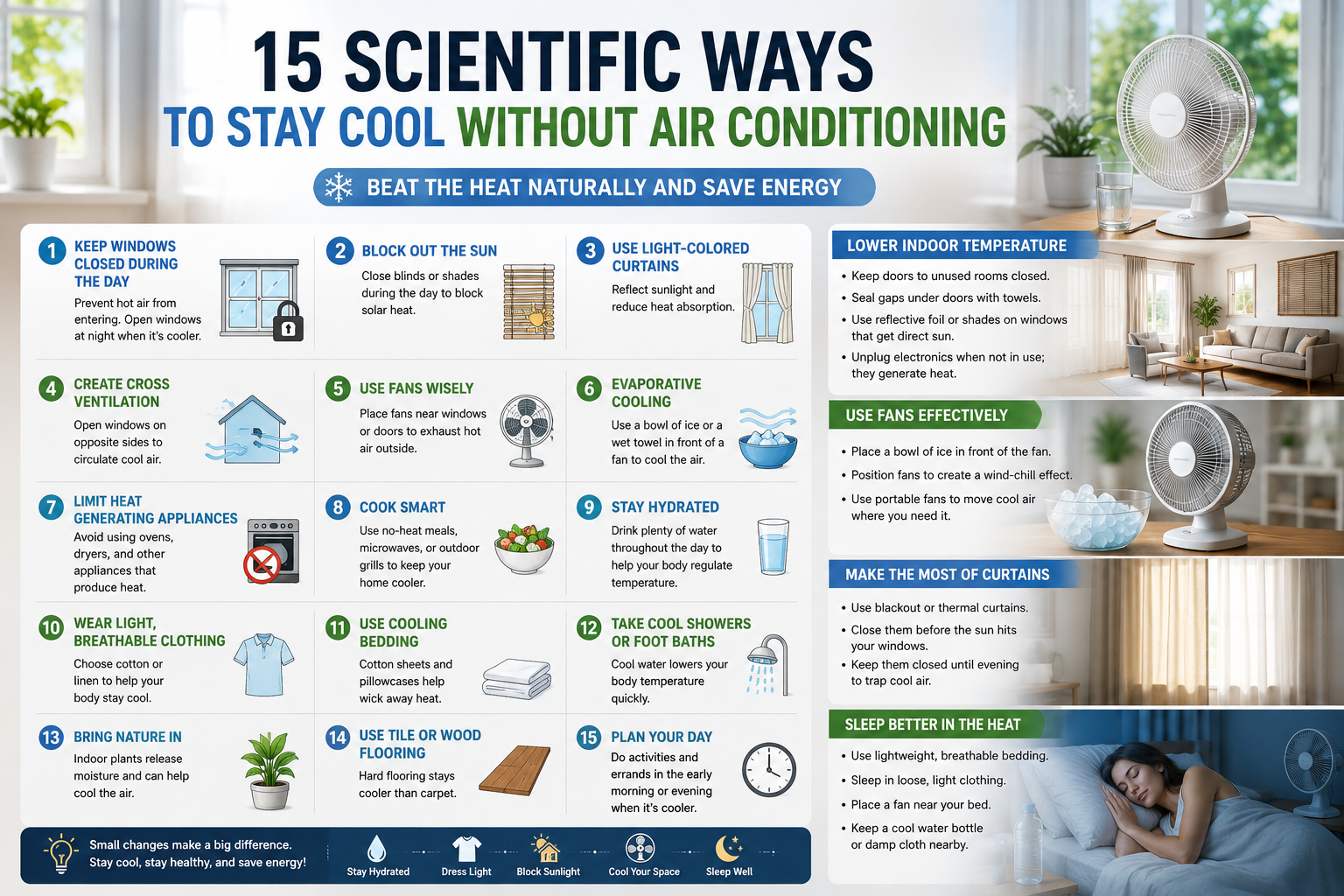
Are you looking for ways to stay cool without air conditioning this summer?
Meta Description: Discover 15 scientific methods based on thermodynamics and physiology to enjoy a comfortable summer without air conditioning. This expert guide comprehensively covers everything from lowering indoor temperatures, utilizing fans and curtains at 200% efficiency, and tips for overcoming tropical nights, to cooling know-how for non-AC outdoor filming sets.
During heatwaves when summer temperatures rise rapidly, our dependence on air conditioning reaches its peak. However, excessive use of air conditioning not only leads to massive electricity bills but also severely weakens the body’s immune system by inducing autonomic nervous system disorders, commonly known as air-conditioning sickness. It is generally known that prolonged exposure to artificial cold air in an enclosed space dries out the respiratory mucous membranes and drastically increases the probability of suffering from chronic fatigue and headaches due to extreme temperature differences between indoors and outdoors.
In actual production fields, there are many synchronous recording environments where external noise or the mechanical background noise of an air conditioner must be perfectly controlled. Consequently, it is common to push through filming in a completely sealed studio in the middle of summer with the cooling system entirely turned off. Many experts emphasize that surviving in such extreme environments requires moving beyond the physical measure of simply blasting cold air. Instead, adopting a scientific approach that understands the thermodynamic structure of the space and controls airflow is a crucial task directly linked to survival.
This complete guide presents 15 scientific methodologies to establish a comfortable indoor environment without relying on the modern convenience of an air conditioner. From strategies to lower indoor temperatures using Bernoulli’s principle to aerodynamic fan utilization, radiant heat-blocking curtain installations, and physiological sleep tips, we provide highly detailed and practical knowledge. Through this guide, you will establish a perfect standard for smartly managing the heat of both your body and space in any non-AC environment.
Fundamental Thermodynamic Environmental Design for Lowering Indoor Temperatures
The very first step to lowering the indoor temperature is to create a structure that blocks heat energy from entering the house and expels trapped internal heat outwards, based on the Second Law of Thermodynamics. Air density changes with temperature, causing convection currents where hot air rises and cold air sinks. It may vary depending on the situation, but simply controlling the direction of window openings and timing strategically can yield the astonishing effect of lowering the average indoor temperature by 2 to 3 degrees Celsius.
Many people tend to throw all the windows wide open during the day simply because it feels hot. However, this leads to the fatal consequence of defenselessly drawing in the blistering external radiant heat and suffocating air. When midday solar energy is baking the earth’s surface, the outdoor temperature is significantly higher than indoors. Attempting to ventilate indiscriminately at this time is akin to walking straight into a giant oven.
This section deeply covers four core methods based on architectural physics and environmental engineering: scientific ventilation techniques utilizing air pressure differences, controlling artificial heat sources generated by electronic devices, and evaporative cooling systems utilizing the heat of vaporization. Furthermore, it delivers detailed solutions for heat management problems that occur in the actual workspaces of creators handling high-spec equipment for short-form video editing.
[Method 1] Applying Bernoulli’s Principle Through Cross Ventilation
To extract hot indoor air, you must actively apply ‘Bernoulli’s Principle,’ a fundamental concept in fluid dynamics. Bernoulli’s Principle explains the phenomenon where fluid speed increases and pressure decreases as it passes through a narrow passage. To apply this in a house, you must design it so that the window on the windward side (where the wind enters) is opened slightly, while the window on the leeward side (where the wind exits) is opened wide. This creates a bottleneck effect as air enters, rapidly increasing the flow velocity.
A common mistake beginners make is opening both front and back windows wide equally, leaving the airflow sluggish and inefficient. If you open the windward window only about 15 to 20 cm to increase the pressure, cool outdoor air will forcefully push deep into the house, much like how a stream of water shoots stronger and further when you squeeze the end of a hose.
According to expert know-how, the ‘golden time’ for this cross ventilation is from the nighttime hours (after 9 PM) when the outdoor temperature drops below the indoor temperature, until the early dawn (before 6 AM). The most scientific ventilation strategy is to completely cool down the heat accumulated in the walls and floors through cross ventilation during these hours, and then tightly close all windows around 8 AM as the sun rises and temperatures climb, trapping the cold air inside.
[Method 2] Preemptive Blocking of Indoor Heat Sources and Standby Power Control
Without us realizing it, home appliances act as small heaters constantly emitting heat. In particular, desktop PCs equipped with high-performance graphics cards, large smart TVs, set-top boxes, and the keep-warm function of rice cookers are the main culprits raising the summer indoor temperature by more than 1 degree. This is because any device with electricity flowing through it inevitably generates heat energy due to electrical resistance.
Looking at actual business application cases, creators who produce 9:16 vertical short-form dance challenges or K-pop content featuring flashy transitions using editing programs like CapCut suffer from severe overheating issues. When rendering heavy 4K video files, the PC’s graphics card and CPU temperatures soar to 80~90 degrees Celsius, turning a small workspace into a literal sauna.
As a troubleshooting method during production and a practical tip, professionals whose main job is editing utilize scheduling functions to run video rendering tasks during the late-night hours when the indoor temperature is at its lowest. Even in a normal household, you must unplug unused appliances or use power strips with individual switches to 100% block the micro-heat generated by standby power, ensuring the house’s base temperature remains low.
[Method 3] Controlling Indoor Humidity Using Evaporative Cooling
The principle where water absorbs surrounding heat energy as it changes state from a liquid to a gas is called the ‘heat of vaporization’ or ‘Evaporative Cooling.’ Mopping the floor with cold water on a hot midday or hanging a wet towel in front of a fan are excellent traditional methods that utilize this evaporative cooling principle to strip heat from the air.
However, the most fatal mistake beginners make is attempting evaporative cooling in an environment where the indoor humidity has already exceeded 70% and reached saturation, such as during the monsoon season or on cloudy days. If there is no more room for the atmosphere to hold water vapor, the moisture in the towel cannot vaporize. This only causes a sticky discomfort index to skyrocket, paradoxically resulting in the worst-case scenario of raising the perceived temperature.
Therefore, as a practical tip, the evaporative cooling method must only be strategically used in clear, dry heatwave environments (relative humidity below 50%). As a recent trend, utilizing the AI weather app on your smartphone to check the real-time external humidity, and then lightly spraying water with a spray bottle on the veranda floor or entryway tiles during dry hours can dramatically lower the temperature of the air flowing indoors.
[Method 4] Microclimate Creation Through Natural Plant Transpiration
Plants perform ‘Transpiration,’ a process where they release water absorbed through their roots into the atmosphere via the stomata on their leaves. Because this process also utilizes the heat of vaporization of water, the air around the plants becomes cooler than the surroundings. By placing several broad-leaved plants near a window, you form a natural defense barrier and a Microclimate that initially cools the scorching heat entering the house.
Many experts recommend intensively placing foliage plants with broad leaves and active transpiration, such as Monstera, Rubber Trees, and Areca Palms, on the veranda or living room windows exposed to direct sunlight. Not only are these plants aesthetically pleasing, but they also act as multi-purpose filters, releasing hundreds of milliliters of microscopic moisture per day through their leaves, lowering the ambient temperature by 1~2 degrees, and purifying the indoor air.
As a precaution, to maximize the cooling effect emitted by plants, you must generously spray water on the front and back of the leaves with a spray bottle twice a day: early in the morning and in the evening after sunset. Wet leaves deflect solar heat and cool the surrounding air much faster. Artificial plants or small succulents with thick leaves that hardly transpire offer zero temperature-lowering effects, so the choice depends on the purpose when selecting plant species.
Aerodynamic Placement of Fans and 200% Utilization of Fluid Dynamics
The core weapon for surviving the summer without an air conditioner is undoubtedly the electric fan. However, most people simply point the fan directly at their faces or bodies and let it blow on them. This is an amateur approach that overlooks the heat generated by the fan’s motor and merely seeks temporary coolness by drying the sweat on the skin’s surface. In fluid dynamics, a fan must act as a powerful blower that creates airflow, circulates the heat throughout the entire space, and drives it outside.
Some studies indicate that if a fan is left running directly on a person in a closed room for a long time, the overall temperature of the room actually rises due to the heat generated by the motor. The person only feels a cooling effect as sweat evaporates; the thermodynamic energy of the space does not decrease at all. Therefore, a fan’s performance differs vastly depending on ‘where’ and ‘in which direction’ it is placed.
This section deeply analyzes four innovative 100% fan utilization know-hows: the Exhaust technique to force out stagnant hot air, a DIY AC system maximizing endothermic reactions using ice, air circulation tips combining air circulators, and seasonal aerodynamic settings for ceiling fans.
[Method 5] Exhaust Fan Placement Facing Out the Window
When the sun sets and the evening arrives, bringing the outdoor temperature lower than the indoor temperature, people often place fans outside the window blowing inward to catch a cool breeze. However, a thermodynamically more efficient method is to turn the fan in the exact opposite direction to build an ‘Exhaust’ system that points ‘out the window.’
According to expert know-how, hot air trapped in concrete walls and floors during the day does not quickly escape on its own just because a window is opened. If you point the fan from inside the room facing out the window, it forcibly pushes the hot indoor air outside. The resulting pressure difference (negative pressure) formed in the room explosively sucks in fresh, cool outside air through other windows or doors.
As a practical tip and precaution, do not place the fan flush against the window screen. Instead, place it about 50 cm to 1 m away from the window, facing outwards. This allows it to gather the surrounding air broadly and form a powerful exhaust airflow through the Bernoulli effect. It is the ultimate on-site move to cool down a room filled with hot, stuffy air in just 5 minutes.
[Method 6] Building a DIY AC System Using Frozen Water Bottles
When there is no physical air conditioner, the most primal and guaranteed way to generate cold air is a DIY ice AC utilizing an Endothermic Reaction. If you freeze water in two to three 2-liter plastic bottles and line them up behind the fan motor or in front of the grill where the air blows out, the fan’s breeze will drastically drop in temperature as it brushes past the ice bottles, pouring out cold air that rivals a cooler.
A mistake commonly made by beginners is freezing plain water or failing to place a towel under the bottles. As the ice melts back into water, moisture in the air condenses on the surface of the plastic bottles, causing a massive amount of condensation (water droplets) that can easily turn the floor into a puddle. You must place a wide, deep tray under the bottles to prevent floor damage.
To add another piece of expert know-how here, when filling the plastic bottles, do not use regular water but rather saltwater loaded with plenty of salt. Saltwater has a lower freezing point than plain water, so it freezes rock-solid at a much lower sub-zero temperature. When it melts, it absorbs significantly more heat from the surroundings, and does so much slower, making the intensity and duration of the cooling effect more than twice as long as plain water.
[Method 7] Indoor Air Circulation Through the Combined Placement of Circulators and Fans
Recently, in addition to regular fans, many households are equipped with ‘Air Circulators’ that borrow the aerodynamics of aircraft jet engines. The choice depends on the purpose; unlike a fan that spreads air widely, a circulator is a dedicated air circulation device that gathers air into a vortex and shoots it in a straight line tens of meters away. In an environment without AC, the key is to divide the roles of these two devices and deploy them in combination.
It is generally known that hot indoor air always gathers towards the ceiling, forming layers. Therefore, if you tilt the head of the circulator a full 90 degrees pointing straight up at the ceiling and run it powerfully, the sauna-like air layer pooled at the ceiling shatters and mixes with the floor air, eliminating the temperature variance throughout the room.
As a practical tip, while the circulator crushes the hot air on the ceiling and stirs the entire room’s air, the regular fan should be rotated horizontally at the eye level where people stay, such as beds or sofas, to blow away the heat of vaporization on the skin’s surface. This ‘two-track vertical and horizontal air circulation’ is the most scientific solution to defeat a suffocating tropical night in a cramped, stuffy room.
[Method 8] Seasonal Forward/Reverse Settings for Ceiling Fans
A recent interior trend sees a rapid increase in households installing large Ceiling Fans in their living rooms or bedrooms. A ceiling fan is a highly efficient cooling auxiliary device that does not take up floor space yet generates massive airflow with its giant blades, dropping the perceived temperature of the entire space by over 2 to 3 degrees. However, many are unaware of the scientific fact that the rotation direction of the blades must be set differently for each season.
A common mistake made by beginners is setting the ceiling fan to ‘Reverse (Clockwise)’ during the summer. Reverse rotation pulls air up toward the ceiling and forces it down along the walls. This mode is mainly used in winter to circulate the warm heating air gathered at the ceiling. If you use this mode in the summer, it paradoxically dumps the scorching heat from the ceiling right onto people’s heads.
According to expert know-how, to overcome the summer heatwave, you must operate the ceiling fan’s remote control or main switch to set it to ‘Forward (Counterclockwise)’. Blades rotating counterclockwise forcefully push the air straight down toward the floor, creating direct airflow on the skin and promoting the heat of vaporization to provide an overwhelming sense of refreshment.
Radiant Heat and Insulation Control Systems Using Curtains and Blinds
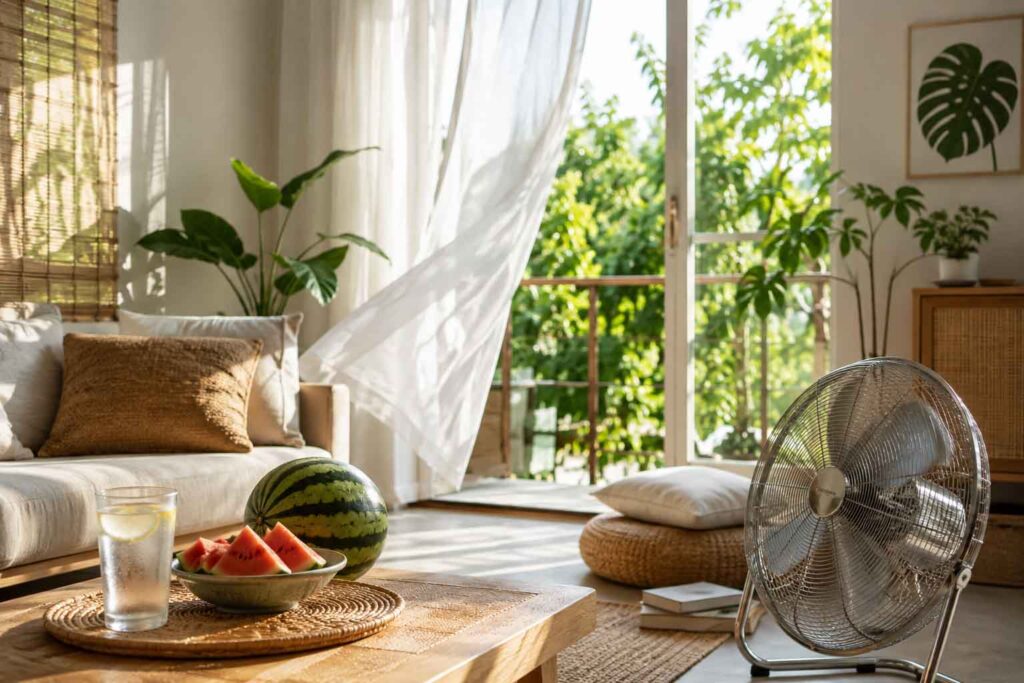
In architectural engineering, the most absolute heat sources that raise indoor temperatures are the sun’s ‘direct sunlight’ and ‘radiant heat’ piercing through the windows. It may vary depending on the situation, but approximately 30 to 40% of the total heat entering a house during summer comes through the glass windows. Solar rays are light energy on their own, but the moment they touch the indoor floors, wallpaper, and furniture surfaces, they convert into heat energy, acting as a giant radiator that slowly bakes the inside of the house.
Therefore, to stay cool without an AC, it is essential to rigorously track the sun’s rising and setting trajectory and design a defense barrier that fundamentally blocks sunlight before it touches indoor objects. Many people hang thin, transparent chiffon curtains for interior design purposes, but these are mere shells with zero physical effect in defending against the heat energy of direct sunlight. To block heat, you must borrow the power of specialized materials engineering that reflects or traps light and heat.
This section covers four core defense strategies that perfectly bounce off thermal radiation entering the room: the principle of blackout curtains that drastically lower the Solar Heat Gain Coefficient (SHGC), the insulation effect of honeycomb blinds embracing air layers, window tinting film technology applied directly to glass, and a traditional cooling technique utilizing the balcony floor.
[Method 9] 100% Direct Sunlight Blocking Using Blackout Curtains
The most reliable and inexpensive way to prevent the temperature of an empty house or an unoccupied room from skyrocketing during summer days (10 AM – 4 PM) is to draw ‘Blackout Curtains’. Blackout curtains are special fabrics made by compressing multiple layers of textile or applying an acrylic coating on the back, bouncing off over 99% of visible light and infrared rays. This physically blocks external solar radiant heat from infiltrating indoors.
A mistake beginners frequently make when choosing blackout curtains is unconditionally selecting dark black or navy curtains. Dark colors are advantageous for blocking light, but the fabric surface itself ferociously absorbs solar heat, turning the curtain into a massive heating element. This is precisely why you feel a wave of hot air radiating from the curtain when you get close to the window.
The expert know-how and practical tip here is to choose an interior color of your liking for the front side facing indoors, but select a blackout curtain with a white or silver coating on the back side facing the window (outdoors) that perfectly reflects light. Because the bright-coated surface reflects solar radiant heat back outside like a mirror, it prevents the curtain itself from getting hot and keeps the indoor temperature cool.
[Method 10] Applying the Insulation Principle of Honeycomb Blinds’ Air Cells
Households that dislike the fluttering or dust of curtains prefer blinds. However, standard aluminum or wood blinds have high thermal conductivity, transmitting summer solar heat straight into the room. In a non-AC environment, the ultimate insulating blind most recommended by experts is the ‘Honeycomb Blind,’ which features a hexagonal, honeycomb-shaped cross-section.
Inside the three-dimensional hexagonal structure of honeycomb blinds, numerous ‘stagnant Air Cells’ that do not mix with external air are formed. Air is one of the greatest natural insulators on Earth. When scorching radiant heat heating up the window tries to enter the room, the hexagonal air cells inside the blinds act as a perfect buffer zone blocking the transfer of heat, dramatically delaying the rise in room temperature.
As a practical tip, to extract 100% of the honeycomb blind’s insulation effect, you must minimize the gaps between the window frame and the blind. Because most of the heat leaking in from outside enters through the open spaces on both sides of the blind, it is crucial to install it tightly flush inside the window frame (recessed mount) to perfectly cut off the heat’s bypass routes.
[Method 11] Scientific Application of Window Tinting Films and Bubble Wrap
In office environments or windows requiring natural light where curtains or blinds cannot be drawn, installing a window tinting film (heat rejection film) that lowers the thermal transmittance of the glass itself is essential. Operating on the same principle as tinting car windows, this is highly advanced nano-engineering technology where a thin film coated with metal particles is attached to the glass to reflect infrared and ultraviolet rays while allowing only visible light to pass indoors.
The so-called ‘뽁뽁이 (Bubble Wrap),’ widely used for winterproofing, is also extremely effective for summer cooling. This is because the air layer in the bubbles blocks heat conduction. A common mistake beginners make when applying bubble wrap or film is merely wiping the glass roughly and spraying just plain water. If fine dust or grease remains on the glass, severe air bubbles form, ruining the aesthetics, and heat leaks through those gaps, plummeting the insulation effect.
As a troubleshooting method and expert know-how, before application, you must fill a spray bottle with ‘soapy water mixed with a few drops of neutral detergent (dish soap)’ and drench both the glass window and the film surface. The soapy water acts as a lubricant, allowing you to easily adjust the position even when the film is on the glass. If you push out firmly from the center to the outside with a rubber squeegee, you can achieve a flawless installation integrated perfectly with the glass without a single bubble.
[Method 12] Blocking Radiant Heat by Spraying Water on Balcony Floors
An apartment balcony (veranda) or a house’s yard is the first line of defense holding heat before it enters indoors. The geothermal heat from balcony tiles boiling under direct midday sunlight pierces through the window sashes and spikes the living room temperature. If there is no AC indoors, you need physical measures to preemptively lower the floor temperature of this external balcony.
Looking at actual production field cases, on historical drama sets or traditional Hanok sets where AC installation is impossible, staff hose down the entire yard with massive amounts of water right before ‘Shoot’ is called to prevent actors wearing multiple layers of Hanbok from getting heatstroke. As the water soaks the dirt and roof tiles on the ground and then vaporizes, it takes away the surrounding heat. This is a classic but highly certain cooling technique that instantly drops the perceived temperature of the entire set yard.
This principle can also be applied in regular homes. Around 2 to 3 PM, the hottest time of the day, drenching the veranda tile floor with a hose or bucket of water allows the evaporating water to forcefully strip away the radiant heat trapped in the tiles. As a practical tip, if you slightly open the veranda window and leave the screen closed, the cooled air from the floor flows into the living room, allowing you to experience an immediate temperature drop. However, it is best to avoid this on days with excessively high humidity.
Physiological Sleep and Cooling Techniques to Overcome Heatwaves and Tropical Nights
The biggest hurdle for non-AC survival in summer is not the daytime when the sun is up, but the sleeping hours when the minimum nighttime temperature refuses to drop below 25 degrees Celsius, creating a ‘Tropical Night.’ According to the Circadian Rhythm, the human body is designed to lower the Core Body Temperature by about 0.5 to 1 degree Celsius compared to normal levels during sleep to allow the brain and organs to rest.
It is generally known that if the ambient temperature is too high and the core body temperature cannot be smoothly dissipated, the brain perceives the body as being in an ’emergency alert state.’ This suppresses the secretion of the sleep hormone melatonin and excites the sympathetic nervous system. As a result, you toss and turn all night or remain in a light sleep, suffering from extreme chronic fatigue and a weakened immune system the next day. To achieve perfect sleep without an AC, you must actively utilize the body’s internal physiological temperature regulation mechanisms beyond merely cooling the space.
This section covers four in-depth and innovative practical techniques: a step-by-step shower method to strategically lower core body temperature before sleep, the principle of touch cooling (Q-Max) bedding using new materials, localized cooling targeting the body’s Pulse Points, and real survival cases of creators forcing short-form shoots through heatwaves in non-AC studios.
[Method 13] Step-by-Step Lukewarm Shower to Lower Core Body Temperature Before Sleep
When you can’t sleep and are sweating during a tropical night, you are engulfed by an instinctual urge to run to the bathroom and take a bone-chillingly cold shower. This is the most common and fatal sleep-disrupting mistake beginners make. When cold water suddenly hits the hot skin surface, the capillaries all over the body constrict rapidly, closing the skin’s pores.
As a result, only the surface of the skin cools down temporarily, but the hot heat trapped deep inside the body loses its exit route, keeping the core body temperature elevated. Furthermore, the body promotes heat-producing metabolism to return the chilled surface temperature to normal, causing a counterproductive effect where sweat pours out and the body heats up immediately after stepping out of the shower.
The correct practical tip and expert know-how is to take a shower starting with ‘lukewarm water at 36~37 degrees Celsius, similar to body temperature,’ 1 to 2 hours before bedtime, gradually lowering the temperature step-by-step. Lukewarm water dilates blood vessels and opens pores, gently dissipating the core body heat accumulated deep inside all day out through the skin. As muscle tension releases and the core body temperature drops naturally, the brain finishes preparing to enter perfect sleep mode (melatonin secretion).
[Method 14] 100% Utilization of the Q-Max of Cooling Bedding Materials
Sleeping under chemical fiber (polyester) or heavy cotton blankets that cannot absorb sweat in a tropical night environment without AC plunges your sleep quality into an abyss. If sweat cannot escape and gets trapped inside the bedding, it not only causes skin maceration or heat rash but also abnormally raises body temperature. In summer, you must entirely replace your bedding with ‘touch cooling’ materials that rapidly absorb and release heat upon contact with the body.
In textile engineering, the degree to which the skin feels instantaneous coolness upon touching a fabric is expressed by the ‘Q-Max (Touch Cooling Index)’. A recent market trend is placing high-functional cooling pads made of materials like Duraron, cooling nylon, or rayon, boasting a Q-Max value of 0.3 or higher, on top of the bed mattress. This prevents the dreadful heat trapping phenomenon that occurs between your back and the floor during sleep. These materials have very high thermal conductivity, absorbing body heat and immediately scattering it into the air.
According to expert know-how, it is best to choose Linen or hemp—materials with the most outstanding breathability on Earth—for your covering blanket. Because there are countless microscopic air holes between the fiber strands, they vaporize the sweat you emit while sleeping as soon as it’s absorbed, maintaining a pleasant crispness. As a practical tip, you must wash your bedding at least once a week to remove sebum and impurities blocking the fiber’s pores to extract 100% performance from cooling materials.
[Method 15] Strategic Localized Cooling of Pulse Points
In a non-AC environment where you cannot cool the air of the entire room, a physiological secret to rapidly and decisively drop body temperature is concentrating on the ‘Pulse Points,’ where thick blood vessels pass closest to the skin surface. The back of the neck on both sides (carotid arteries), the inner wrists, under the armpits, and the groin (inguinal region) house major arteries and act as main control towers regulating the temperature of blood flowing throughout the entire body.
When you feel hot no matter how strong you run the fan, try lightly placing an ice bag, rock-solid ice packs, or cold wet towels on these pulse point areas for just about 5 minutes. As the cooled blood is pumped by the heart and spreads instantly to organs and muscles all over the body, you can experience a thrilling core temperature drop equivalent to plunging your whole body into ice water.
A precaution and a mistake beginners make is placing ice or ice packs directly on bare skin for a long time without wrapping them in a towel. This can cause localized frostbite or skin necrosis, and the brain may mistake it for extreme cold, triggering an adverse reaction that actually raises the core body temperature. You must wrap the ice in a single layer of dry towel or handkerchief and conduct short, intense cooling sessions not exceeding 10 minutes.
Cooling Case Studies for Visual Comedy Short-Form Filming in Outdoor and Non-AC Studios
In the actual production environments of creators, they face a dilemma where they must secure both survival and work quality under the extreme constraints of a non-AC environment. Recently, “dialogue-free slapstick comedies” or short-form content featuring animal characters (cats, dogs, pigs, etc.) with exaggerated actions have dominated platforms like TikTok or Shorts. These are mainly shot in a 9:16 vertical format and demand highly dynamic and relentless movement.
Looking at actual filming cases, to perfectly exclude the influx of a mechanical AC background noise during audio recording and to maximize only high-quality impact sounds or environmental sounds (sound effects), shoots are often forced to proceed while sweating profusely without an AC in enclosed summer sets or against the backdrop of an outdoor Hanok village under the scorching sun. Performers dressed as Joseon-era scholars or wearing thick animal mascot suits are especially driven to the brink of exhaustion.
A troubleshooting method and the latest practical tip to overcome these harsh conditions is the introduction of ‘Silent Ice Vests’ and ‘Ultra-Compact Neck Coolers.’ By wearing thin ice vests containing special refrigerants inside thick costumes, the rise in core body temperature is fundamentally suppressed. Furthermore, the survival know-how of on-site staff involves employing a guerrilla-style ventilation tactic: operating giant industrial Exhaust Fans only during the extremely short standby times between ‘Shoot’ and ‘Cut’ to suck the stagnant heat out of the set in just 10 seconds.
Core Non-AC Survival Checklist for Practical Application
To comfortably overcome midsummer without an AC, this is the core checklist you must inspect and execute in your home environment immediately.
□ Are you keeping the windows closed during midday when the outdoor temperature is higher than indoors, and executing Bernoulli cross ventilation only at night and dawn? □ Have you eliminated indoor micro-heating by cutting off the standby power of unused TVs, set-top boxes, PCs, etc.? □ Have you tried expelling hot air by pointing the fan ‘out the window (exhaust type)’ rather than towards a person? □ Did you build a DIY ice AC by placing a tray and frozen plastic bottles mixed with salt behind the fan? □ Are you shattering the hot air layer by pointing the air circulator toward the ceiling (90 degrees)? □ Is the ceiling fan in the living room properly set to the summer mode, ‘Forward (Counterclockwise)’? □ Have you installed blackout curtains with a white (or silver) light-reflecting back side near the windows? □ Did you flawlessly apply window tinting film or bubble wrap to the glass using soapy water, leaving no air bubbles? □ Did you take a step-by-step cool-down shower with ‘lukewarm water,’ not cold water, 1 hour before sleep for a tropical night’s deep sleep? □ Have you entirely replaced your bedding with highly breathable linen blankets and cooling pads with a high Q-Max index?
Conclusion
Coolly overcoming heatwaves and tropical nights without an air conditioner is by no means painful endurance. It is a highly scientific practice of accurately understanding and controlling the aerodynamics of space, the Second Law of Thermodynamics, and the human body’s physiological temperature regulation system. Defend against radiant heat during the day with light-reflecting blackout curtains and honeycomb blinds, and forcibly evict stagnant heat at night using cross ventilation based on Bernoulli’s principle and exhaust fan placement. DIY saltwater ice bottle cooling, concentrated pulse point cooling, and lukewarm showers and cooling bedding that manage your core body temperature will keep your condition at its peak in any extreme non-AC setting. We hope you welcome the most natural and healthy summer by following these 15 practical guidelines that smartly utilize environmental and physical mechanisms.
FAQ
Q1. Is it really correct to keep the windows closed because it’s too hot during the day? Won’t it be hotter without ventilation?
During a heatwave midday (11 AM – 4 PM) when the outdoor temperature is higher than indoors, opening windows invites blistering hot air and direct sunlight to pour in, turning your room into a sauna. It is scientific to keep windows and curtains tightly closed during the day to trap cool air, and ventilate late at night or early dawn when the outdoor temperature drops.
Q2. Why is the exhaust method of pointing a fan out the window cooler?
Forcibly pushing hot indoor air out the window creates a slight negative pressure (pressure drop) inside the room. To fill this pressure gap, fresh, cool outside air is explosively sucked in through other windows or doors in the house, instantly lowering the temperature of the entire room.
Q3. Why should I freeze saltwater instead of plain water for ice plastic bottles?
Saltwater has a lower freezing point than pure water, so it freezes at much colder sub-zero temperatures. When placed in front of a fan, the saltwater ice absorbs significantly more surrounding heat (endothermic reaction) as it melts, making the cold wind effect much stronger and lasting more than twice as long as plain water.
Q4. Why does a cold shower on a hot summer night interfere with deep sleep?
When cold water touches your skin, the brain perceives it as extreme cold and tightly closes all capillaries and pores to prevent heat loss. The outside feels cold, but the core heat trapped in bones and muscles cannot escape. Shortly after, sweat pours out and body temperature rises, fatally disrupting sleep (melatonin secretion). A lukewarm shower is the answer.
Q5. Are there specific colors of blackout curtains I must absolutely avoid buying?
You must absolutely avoid curtains where the back side facing the window is dark black or navy. Dark colors absorb solar radiant heat directly, turning the entire curtain into a hot heating element. You must choose products with a white or silver-foil coated exterior that reflects 100% of light.
Q6. What is the biggest difference between an air circulator and an electric fan?
A regular fan spreads air widely to dry a person’s sweat, while an air circulator applies aircraft engine fluid dynamics to gather air into a vortex and shoot it straight for tens of meters, mixing and circulating the entire air layer of a space. Circulators should be pointed at the ceiling to break up hot air.
Q7. Is it true that the rotation direction of a ceiling fan is different in summer and winter?
Yes, exactly. In summer, the blades must turn ‘Counterclockwise (Forward)’ to push air vertically to the floor, creating cool evaporative heat. In winter, they turn ‘Clockwise (Reverse)’ to draw air to the ceiling and push warm air down the walls, increasing heating efficiency.
Q8. When it’s too hot, where on the body is ice packing the fastest and most effective?
You must target the ‘Pulse Points’ where the major arteries sending blood throughout the body meet closest to the skin. Simply holding ice or a cold towel to the back of your neck, under your armpits, and the inside of your groin for 5 minutes circulates cooled blood throughout your body, providing an instant cooling effect like jumping into ice water.
Q9. Does spraying water on the veranda floor in summer help lower the temperature?
It is very helpful. Veranda concrete tiles heated during the day are a source of radiant heat that holds and spews heat into the living room. Drenching the floor with water at midday causes the water to vaporize, stealing an enormous amount of heat from the tiles (evaporative cooling) and preemptively plummeting the perceived temperature of the veranda and living room.
Q10. When cross-ventilating, can I just open both front and back windows equally wide?
You must open the windward window narrowly and the leeward window wide open to apply Bernoulli’s principle, causing the flow velocity to increase rapidly. Just like squeezing the end of a rubber hose makes water shoot out powerfully, cool outdoor air forcefully strikes deep into the house through the narrow gap.
Q11. Does hanging a wet towel keep you cool even during the monsoon season or on high-humidity days?
It actually backfires horribly. During the monsoon season when the air is packed with water vapor (humidity over 70%), the moisture in a wet towel cannot evaporate. The heat of vaporization effect becomes zero, and it only explodes the stickiness and discomfort index of the house, turning it into a sauna, so you must absolutely avoid this on humid days.
Q12. How does the insulation principle of honeycomb blinds differ from regular wood blinds?
Honeycomb blinds have a cross-section shaped like a hexagonal honeycomb, trapping air inside. The stagnant ‘Air Cell’ has extremely low thermal conductivity, acting as the best insulator on Earth. Even if solar heat passes through the glass, it cannot cross this air layer, dramatically preventing the indoor temperature from rising.
Q13. How can I flawlessly apply bubble wrap or tinting film to a window without air bubbles?
After thoroughly cleaning the glass surface, fill a spray bottle with soapy water containing a few drops of ‘dish soap’ and drench the window and film (bubble wrap). The soapy water acts as a lubricant so you can adjust the position freely. Pushing with a rubber squeegee perfectly squeezes out micro-bubbles and moisture, ensuring 100% adhesion to the glass.
Q14. Are there criteria I should check when choosing a cooling pad or cooling bedding?
You must check the ‘Q-Max (Touch Cooling Index),’ which measures how instantly you feel coolness when the fabric touches your skin. You should lay a product with a Q-Max index of 0.3 or higher (Duraron, cooling nylon, etc.) on top of your mattress to prevent the heat-trapping phenomenon that occurs on your back while you sleep.
Q15. Does the room temperature rise even if I leave my computer or TV in standby power mode?
Yes, even in a standby power state with minimal electricity flowing, constant micro-heating occurs due to the resistance of internal circuits. Especially in a closed room during summer, you must completely unplug unused electronics or cut 100% of the power using a switch-type power strip to lower the base temperature of the space.
[Site Policies]
■ About Us We provide verified, expert information on health, climate change, and field safety protocols.
■ Contact www6812@naver.com
■ Privacy Policy This website uses cookies to serve personalized ads through Google AdSense. You can disable cookies at any time through your browser settings.
■ Disclaimer All information on this site is for informational and educational purposes only and does not substitute professional medical or legal advice. The operator assumes no liability for any actions taken or outcomes resulting from the use of this information.
📌 함께 보면 좋은 글
- Ultimate Guide to Chronic Summer Fatigue
- The Fatal Impact of Heatwaves on Heart Health
- 15 Scientific Ways to Stay Cool Without Air Conditioning
- Safest Time to Exercise During a Heatwave
- Ultimate Guide to the UV Index
- Pet Safety Guide During Heatwaves
- 12 Scientifically Proven Methods for Deep Sleep
- Ultimate Hydration Guide
- Heat Stroke Symptoms: 10 Warning Signs
- 2026 Extreme Heat Wave Guide
[Related Articles]
👉 Ultimate Guide: Heatwaves and Heart Health (Click here)
[References]